The 2025 Brisbane Truck Show will offer an in-depth look at the latest e-axle technology from around the world, so don’t miss out on the opportunity to discuss the potential efficiency benefits for your fleet.
The 2023 Brisbane Truck Show saw axle manufacturers shine, with an impressive array of electric axle (e-axle) options that are capable of powering up the sustainability benefits of truck and trailer combinations into the future.
While many come to the show to check out the latest trucks and trailers on offer, the array of parts and accessories on show is world class, as the biggest brands roll out their latest innovations – in many cases, for the first time.
At the last show, an emerging theme was regenerative e-axles for use on trailers, with some examples already being put to work in trials around the country.
An example that drew large crowds in 2023 was SAF-Holland with its TRAKr e-axle, featured on a McDonald’s fridge trailer built by FTE, which is already operating on Australian roads.
The TRAKr e-axle acts as a regenerative braking system, harvesting kinetic energy and converting it into electricity that can be stored in a lithium-ion battery and used to power accessories like a fridge unit, lifting platform or crane.
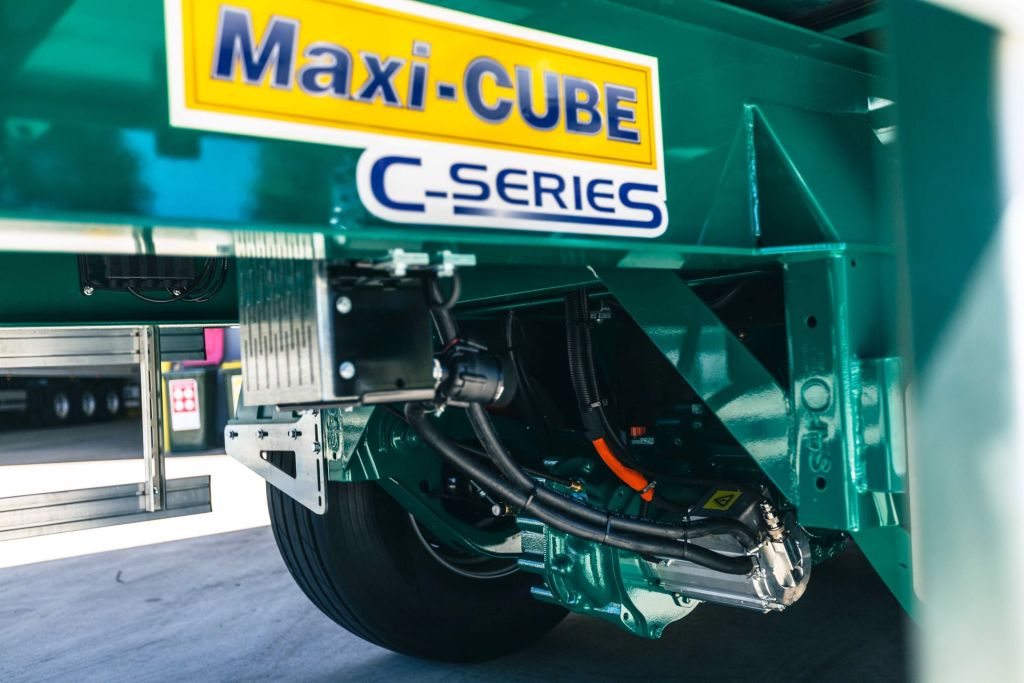
At the last show an emerging theme was regenerative e-axles on trailers, with examples being put to work in trials around the country
Interestingly, the TRAKr unit doesn’t feature rare-earth minerals or even copper, adding to its clean credentials, and according to SAF-Holland it can generate up to 20kW of power – eliminating the need for diesel generators to run auxiliary systems.
Dana had its Spicer eS9000r e-Axle at the 2023 Brisbane Truck Show too, which consists of an electric motor, power system and transmission all built into a drive axle suitable for GVMs up to 10.6 tonnes.
The eS9000r e-axle produces 237kW and up to 9,000Nm of torque (yes, you read that right), while weighing just 370kg, allowing it to be retrofitted in place of an existing truck axle group to provide serious assistance.
Another electric axle system on display was BPW Transpec’s ePower Axle, which is a regenerative unit that uses two generators to double power and reliability, and the manufacturer says it can lead to fuel savings of up to 4,000 litres per year in certain applications.
BPW says intelligent energy management ensures the battery reserves are carefully controlled, even in heavy traffic or during long journeys, and it has its own cooling system to further enhance efficiency
and longevity.
VE Motion is a local innovator that showed its powered trailer technology at the inaugural TruckShowX 2024, sharing its plans for both its e-trailers and a parallel hybrid system that can be retrofitted to diesel trucks.
The company is made up of Arends Trailers, which specialises in light-weight aluminium semi-trailer design and manufacturing, and Vibe Energy, which focuses on grid-connected generation assets.

Another e-axle on display was BPW Transpec’s ePower axle, which is a regenerative unit that uses two generators to double power
VE Motion’s hybrid truck system works much like the parallel or ‘closed loop’ hybrid systems in passenger cars, placing an electric motor and battery between the transmission and driveline. The e-trailer on the other hand utilises a fully-integrated e-axle.
Both the powered trailer and hybrid systems aim to reduce diesel fuel use by up to 50 per cent while retaining the range benefits of an internal combustion engine (ICE) truck.
More recently, Move Engineering Group revealed its ground-breaking powered trailer concept that claims a 58 per cent reduction in diesel use and 50 per cent less emissions, showcasing the clear benefits of powered axle groups for heavy combinations.
The West Australian-based group describes its team as ‘visionary futurists’ for the heavy freight transport and mining sectors, as it pioneers highly efficient powered trailers.
“The concept of a ‘powered trailer’ stems from the idea to add either regenerative energy and/or motive power capabilities to a heavy goods trailer,” says HVIA Chief Technical Officer, Adam Ritzinger.
“It is an incredibly innovative and exciting freight transport decarbonisation opportunity that has recently emerged from within HVIA’s member base.
“It is exciting and inspirational to witness the application of ingenuity, engineering and design expertise to a truly new transport endeavour, right here in Australia.”
Super-single setback
Many of the e-axle options require the use of super-single tyres, Smedley’s Engineers Robert Smedley explains, which coincidentally also provide a fuel-use saving of up to eight per cent. In Australia, though, operators face a payload penalty if they choose to run ‘singles’.
“The conversation has moved beyond just high-productivity trailers in Australia, to now looking at things like aerodynamics and axles, but one thing that’s going to have to happen in order for e-axles to be widely adopted in Australia is the move to super-single tyres,” he says.
“The reality is that most of the world moved to super-single tyres at equivalent masses a long time ago, yet Australia hasn’t and that’s something that needs to be addressed.
“The only roadblock at the moment isn’t science, it isn’t engineering – it’s the state governments.”
While e-axles promise to offer fuel use savings of up to 10 per cent, Smedley points out that the efficiency benefits of super-single tyres are similar.
Combining super-single tyres with e-axles, then, could offer a cumulative fuel-use saving of nearly 20 per cent.
“You also get a reduction in rubber use, tyre life is generally longer as well, so there’s a whole lot of other sustainability benefits on top of fuel efficiency,” he says.
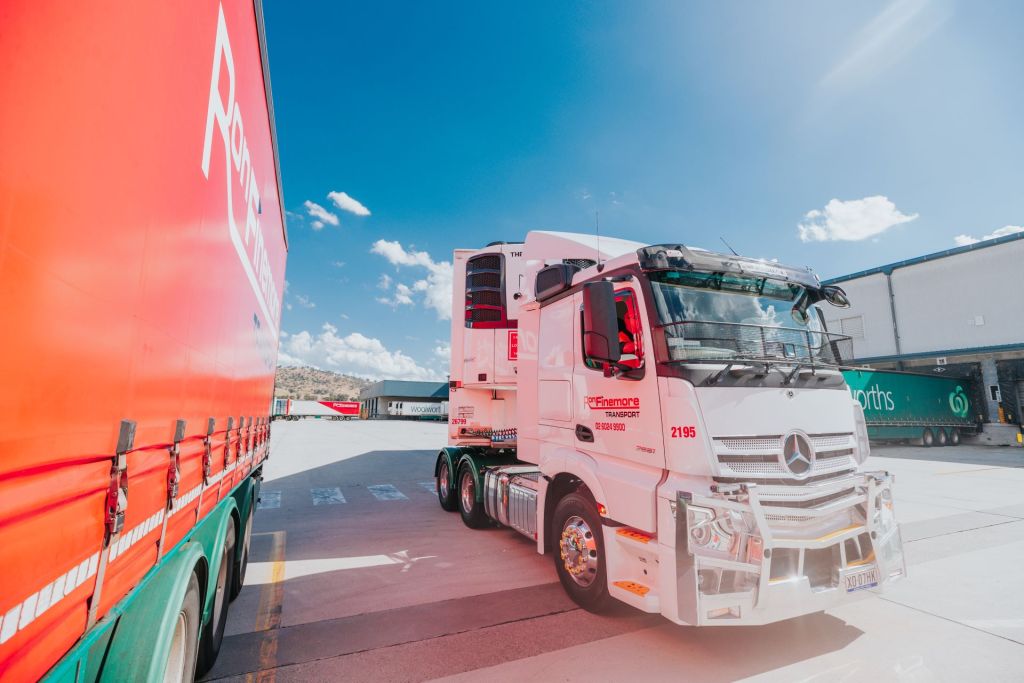
Ron Finemore Transport is among the biggest users of super single tyres in the country, which it claims deliver significant fuel savings
The reality is, current laws and regulations do not contain provisions for powered trailer axles, which comes down to how new the technology is – at least in Australia where no comprehensive trial has been undertaken.
“We’re actually working on that as an industry association,” Ritzinger adds.
“It was around a year ago when a couple of our members started making noise about powered e-axles, so we immediately formed a working group and developed a discussion paper, and since then interest in the topic has rapidly accelerated.”
The HVIA team has been working on removing the regulatory roadblocks standing in the way of powered e-axles, but Ritzinger says the process will take several years to finalise.
“We’ve been working behind the scenes on two things,” he says.
“Our first project is short-term, and will develop a set of guidelines approved by road managers that industry can use to undertake small-scale field trials of powered trailers featuring driven axles. We expect to have those guidelines approved and ready to go during 2025.
“Our second project is long-term, and will work with regulators to investigate and reform the regulations that need revision in order for powered trailers to eventually operate normally on Australian roads.”
Ritzinger recently visited innovative European manufacturer Van Eck Trailers at its headquarters in the Netherlands after the 2024 IAA Transportation show, to take a closer look at its prototype powered dolly.
After seeing it in action, he believes the technology could be applied successfully in Australia.
“What we saw at Van Eck was an impressive display of engineering design and innovation in action, that could offer an interesting avenue for transport decarbonisation in Australia,” he says.
“Given the engineering expertise that exists on our shores, similar solutions could be readily developed by HVIA members for our local market, once HVIA’s work in solving the regulatory roadblocks progresses.”
But how viable are e-axles right now in Australia?
Efficiency at play
While trials of powered, or drive axles, are yet to take place in Australia, the use of regenerative axles is underway right now. As Managing Director and Senior Engineer at Smedley’s Engineers, Robert Smedley, points out, though, it’s all about pairing the right e-axle to a specific truck and trailer combination.
“They are all different; some are twin motors, some are single motor, some use a gearbox, some are air-cooled, some are water-cooled, and some are only doing recuperation under deceleration and braking while others are recuperating all the
time – even under acceleration,” he says.
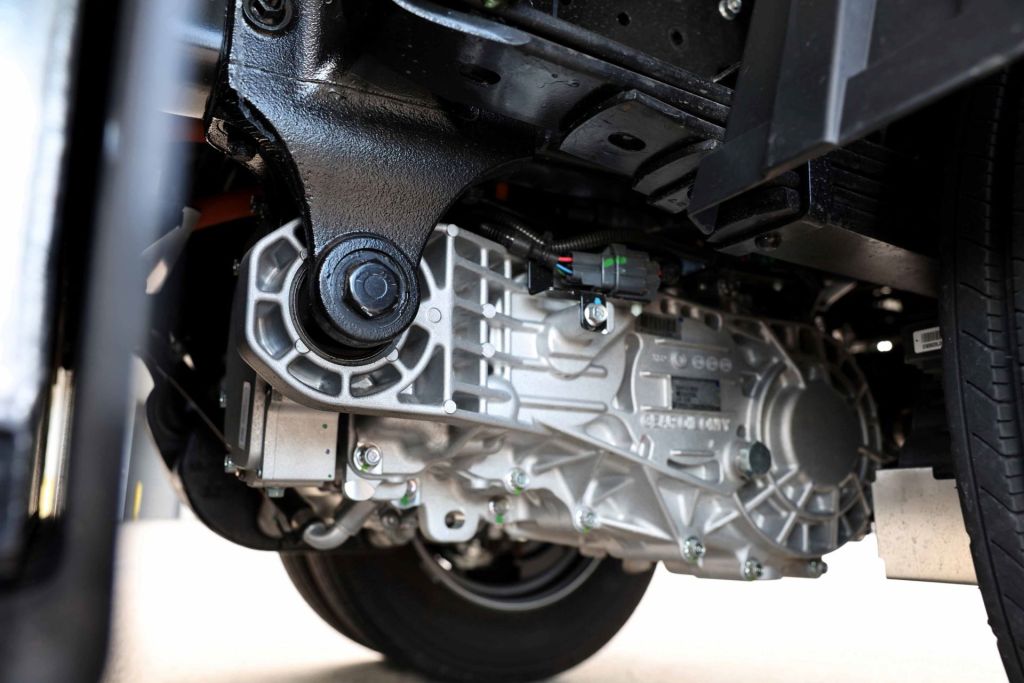
The Fuso eCanter features a smart e-axle, which incorporates an electric motor in the axle
“So there’s some very different approaches to the problem, and the reality of that landscape is those solutions will all work differently in practice because each fleet has a unique use case. What works for some fleets may be different to what works for other fleets.”
The advice for fleets looking to incorporate e-axles into their trailers, Rob Smedley says, is to shop across various brands rather than opting for the same axle manufacturer they have always used.
“They should be going and asking a lot of questions around how this solution is unique and beneficial to their use case, rather than using the same brand they typically always buy,” he suggests.
While it’s critical to establish just how much energy generation is required for a particular application, it is equally important to consider the energy recuperation method.
“We’ve done a few now, so we did some work on the FTE trailer for McDonald’s and A-doubles that are running e-axles, and also have a cycle analysis tool that can tell us the power usage required for a route – so how much power a combination will require and how much regeneration is possible on that route right down to a specific route, truck make and combination type,” Smedley notes.
“Then if you’re running line-haul and almost never touching your brakes, you would want a system that offers constant regeneration to power your fridge.
“But if you’re in stop-start traffic in a metropolitan area, you’d be able to get away with regeneration only under braking or deceleration.”
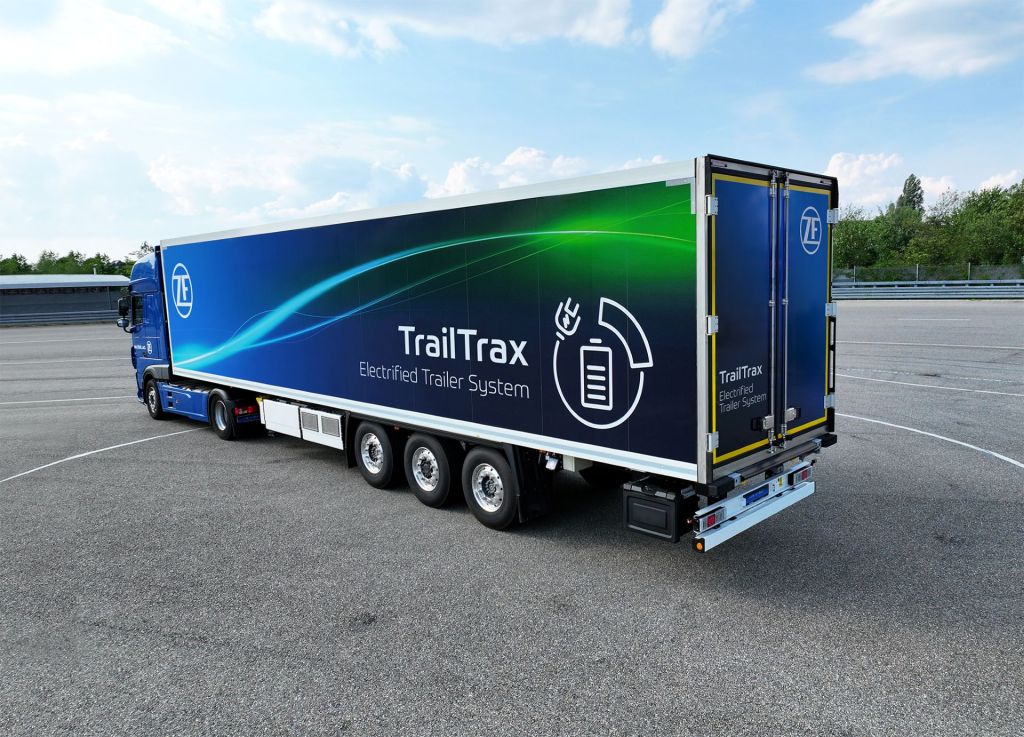
ZF’s electrified trailer concept TrailTrax system provides driving propulsion as well as brake energy recuperation
The solution, he believes, is to talk to your preferred engineer or an industry body like the HVIA about the best e-axle option for your specific vehicle configurations.
“My one concern is that fleets need to get themselves fully informed on the differences in technology that are available, because I’d hate for an operator to buy an e-axle that isn’t suited to their needs,” he says.
“Reach out to the HVIA or an engineer to work on the right e-axle set-up for your needs. That’s the main piece of advice I’m giving operators.”
Full steam ahead
While the prospect of a fully-powered trailer might seem unlikely, the concept is already being trialled overseas. However, it’s energy harvesting axle solutions that can offer real efficiency benefits – today.
“Regenerative e-axles can definitely be used right now to improve efficiency in some applications,” Smedley says.
“The number-one use case at the moment is refrigerated vehicles, regardless of whether it’s highway or local, and the reason for that is they no longer need to spend the money on diesel to run the fridge.”
While regenerative axles can be used right now, their powered counterparts require various changes to Australian Design Rules (ADRs), Road Vehicle Standards Act (RVSA) and Heavy Vehicle National Law (HVNL).
With among the world’s most innovative trailer manufacturers, Australia is positioned to lead the way in development of powered trailers
The way forward
As Australia’s transport industry scrambles to decarbonise, operators will be required to factor in efficiency benefits across their entire vehicle – from the powertrain to aerodynamics, and of course axles.
E-axles offer serious sustainability benefits without the need for a new prime mover, and with one of the world’s most innovative trailer manufacturing industries Ritzinger thinks Australia is in a good position to lead the way.
“We’ve always had a huge amount of innovation in trailer design here in Australia, so there’s absolutely no reason that our own trailer builders in our own industry cannot figure out the most optimal use of this technology,” he says.
“So we certainly have the expertise and innovation on our shores to be able to make this technology work as we strive to decarbonise the transport industry.”
The 2025 Brisbane Truck Show will offer an in-depth look at the latest e-axle technology from around the world, so don’t miss out on the opportunity to discuss the potential efficiency benefits for your fleet.

Electric lingo
The world of e-axles is one riddled with lingo, so what does it all mean for operators? This brief guide should help!
Motors types: E-axles use either synchronous or asynchronous motors, both offering distinct pros and cons. Synchronous motors are simpler, cheaper and run at a fixed speed. Asynchronous motors, on the other hand, are more complex but offer greater efficiency due to their variable speed. The simpler synchronous motors do generate drag, but the asynchronous don’t when not recuperating.
Number of motors: Single motor e-axles typically allow for a larger unit, but require a differential or geared drive to each hub. Dual-motor options, on the other hand, can be direct drive and are therefore more efficient. Both have their place, depending on packaging and energy requirements.
Drive style: E-axles are either direct drive or geared, and that usually comes down to whether they use a single electric motor or multiple units. A single motor solution requires a geared arrangement, which is less efficient due to losses in the gearbox and differential, but provides an opportunity for a larger motor to be packaged.
Cooling options: Much like engines and other mechanical systems, the option of air, oil or water cooling is available. While water cooling may improve durability and thermal efficiency, it weighs more and adds complexity to the system. Air-cooling on the other hand reduces cooling efficiency, which often requires a motor to run at a lower output. Of course, complex cooling systems also add to the cost of an e-axle.
Energy recuperation methods: Energy can be recuperated in a number of ways, but typically it is generated during braking or deceleration efforts. There are, however, e-axle options that generate electricity during all forward motion, which increases drag and requires more ‘energy in’, but suits scenarios where a vehicle maintains a constant speed for prolonged periods and isn’t operating in stop-start scenarios.
Recuperation ratings: The rate that the electric motor is rated to generate – ranging from 20kW right up to 80kW – is measured in kilowatts (kW). Rates higher than 20kW require brake blending in Europe, due to the strong braking forces generated.